

This is a topic which is very close to my heart. I come from a land (Read India) where hustle never stops. There are educational institutes that prepare students for educational institutes that prepare students for more educational institutes. If you are from India, you know what I mean. If not, let me take a moment to explain.
Imagine you are in a kindergarten and need specific kind of education to be able to clear entrance exam for very prestigious school for grade 1. Fast forward a few years and you are preparing for college entrance exams in you high school. Then you go to the college and get placed in companies. This is a gruelling education system that a typical student goes through in India. I did as well.
For me the problem after I started working was that the metric of measuring success wasn’t clear anymore. I had annual appraisals but the results were not very easily quantifiable and depended on a lot of qualitative and subjective factors. This leads to a focus shift towards other metrics which aren’t a true indicator of success and fulfilment. It led to a deep calling towards the hustle culture of the organizations. Busy calendars were glorified. It was almost as if busier the person, the more important he was. A person’s self worth is attached to their productivity (Or rather the business).
In this context, many organizations and teams have a way of calling out to the people through the ‘Challenges’ that they will throw at the people leading to immense learning. Now don’t get me wrong. There is nothing wrong with the pursuit of healthy challenges at work. After all stepping outside of your comfort zone and solving the challenges is the way you grow in your career. But it is equally important to be able to identify healthy challenges from the non healthy ones.
It is with this thought that I once sat down to breakdown the typically kinds of challenges one can find at a workplace and identify the healthy ones. A quick disclaimer – A good chunk of the framework is drawn from my personal experiences and may be a bit tilted towards the kinds of cultures and industries that I have worked in. Feel free to let me know in case I have missed out on something, some aspects that you relate to, or in general if you have a point of view on this.
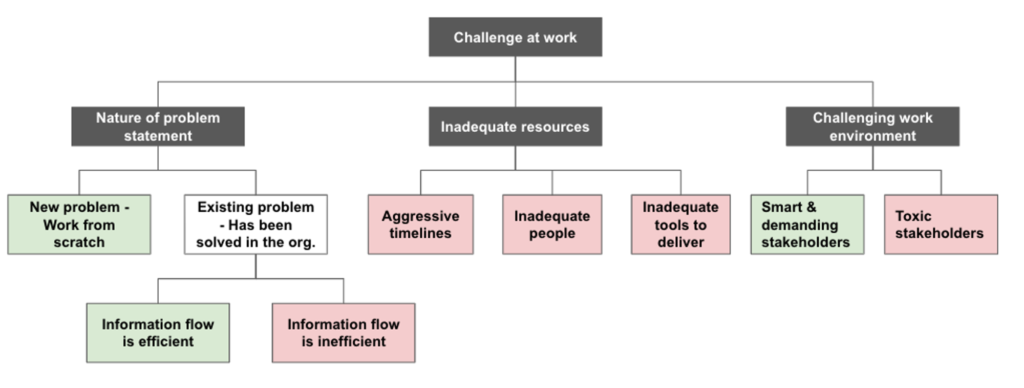
Now let’s get deeper into each of these elements:
- New problem – Work from scratch: This by its nature is a good problem statement to be working with. Of course yu have to consider more factors like alignment with company strategy, your personal objectives and goals etc. But by and large, I will be happy to work on these kind of problem statements. Eg. When I was in Europe, I was working with an E-Commerce company in the fashion space. There I was leading a project around exploring sustainable business models in the fashion space. That I feel was a new problem statement that no one in the industry had an answer to. Hence the excitement in solving for that
- Existing problem statement that has been solved in the organization but the information slow in inefficient. This one is a bit hard to explain. So, let me dive straight into an example. During my time in consulting, I was working on an E-Commerce growth project for a client. There was a parallel very similar project running in the organization which was probably a month ahead of us. Expectations were to replicate a similar approach here, however the information flow was so broken that it became the biggest challenge in the project. Not the problem statement but just getting access to information that was already there in the organization! I would never consider that as a healthy challenge to have.
- If the problem statement has been solved in the organization and the information flow is efficient, then the team can actually focus on customizing the solution for the particular problem statement and drive business results. This is still a healthy challenge to be operating in
- Aggressive timelines: I have worked across cultures and feel that this is something that is more prominent in the Eastern cultures. Indian and Chinese companies are typically plagued with this. Almost always the timelines are very aggressive. I believe this is comes from, in equal parts inefficient planning from the leadership and heavy ambitions (Due to the high growth that these economies are going through). This thus becomes an exercise in balancing ‘Ambition vs practicality’. My personal belief is that the leaders of today in India err on the side of excess ambition since there is no cost (Monetary, value etc.) of overtime work in white collar work. Net net, as an employee this is a challenge best avoided. I would rather try and look out for an employer who has gotten the ‘Ambition vs practicality’ better managed
- Inadequate # of people: This again is an extension of the previous point and a challenge best avoided. This is mostly a result of cases where organization looks at cutting people related costs and starts loading more work onto existing employees. Again, I feel this neither helps me grow in my career nor does it enable me to live out my best life. Best avoided
- Inadequate tools to deliver: Similar to the prior 2 points, this is best avoided. An example form my revious experience from consulting, the organization’s leadership had committed a tool to the client that we didn’t yet have. This led to me working endless days and nights just to be able to come up with something that can pass off as a decent tool to deliver to the client. Again – Doesn’t help me and doesn’t help the company build strong relationships with clients/ customers/ consumers. Best avoided
- Smart & demanding stakeholders: This one is interesting. Having smart and demanding stakeholders can make my life difficult in the short term but can also help me grow so much in the long term. Working with these people can be challenging but also highly rewarding. I would like to take up this challenge whenever provided with an opportunity
- Toxic stakehoders: Sometimes, there can be a very slim line between points 7 and 8 and it can become very difficult to categorize the stakeholder as smart & demanding or toxic. An example of a toxic stakeholder that I worked with (In the guise of a smart & demanding stakeholder) – In one of my roles as the Chief of Staff to a CEO of a manufacturing company in South East Asia, the CEO was super sharp and demanding but working closely with him made me realize his utter lack of respect and empathy towards the team. This would often lead to disrespecting people and profanity in the office. I quickly realized I was dealing with an extremely toxic boss and things (And as a result my life) will never improve. The best thing to do in these situations is to move on.